Web Analytics
Showing posts with label Telecommunication. Show all posts

Saturday, December 15, 2012

Will Samsung Be Number 1 In Mobile Device Market?

"Top 6 reasons why Samsung will top mobile device seller in consumers & enterprise market"

1. Timothy Wagner, who runs the Texas-based Samsung unit has a vision to capture top slot in Enterprise market. Company has vision and company is making investment in this direction.

2. Apple is top seller of company-issued smartphones. As per IDC analyst Stacy Crook they will hold the position till 2016. Apple has one-size-fits-all formula but Samsung is ready to partner with third-party software makers to target specific industries.  This will help Samsung to crate new market. 

3. Samsung is fast capturing the Blackberry's market. This is a quick opportunist movement.

4. Samsung is promising to lower companies’ mobile-computing costs. CIO loves to hear this considering budget for IT department is reducing every year.

5. Instead of multiple handset models offered, Samsung decided to focus on one handset for its flagship phone. Samsung Electronics (005930) moved 18 million such handsets, while Apple (AAPL) sold 16.2 million during the three-month period, says the research firm. This will actually boost the world wide branding for Galaxy just like ipod, iphone, ipad.

6. Samsung makes its own chips to power phones, Super Amoled handset displays, and flash memory for internal storage for its Galaxy S, the Galaxy S II, and now the Galaxy S III.

To be market leader, Samsung might have to distance itself from Andriod as Google is focussing mainly consumer market. This will reduce security risk from various malware.


Wednesday, October 31, 2012

how to select cloud computing vendor?

Clients have begun to prioritize their criteria for purchase around speed/security of the offering, along
Cloud computing represents a significant evolution in information technology (IT) service offerings, creating a powerful and flexible way to access the latest technology services while still managing IT costs.When it comes to choosing a cloud computing vendor, however, there are thousands of options. And finding the right one can be as tricky as predicting the weather.

Clients have begun to prioritize their criteria for purchase around speed/security of the offering, along with its price and support.

Here is a brief guide on how to select a cloud computing vendor.


Technical buying criteria

  1. Firewall, access to Cloud (Enterprise Only), isolated server environment
  2. Available operating system images and compatible software support
  3. Software development tools to track project plan, software versioning, debugging tools
  4. Ability to increase the size of the image (RAM CPU hard drive) after it has been created within a server or across  multiple servers
  5. On boarding experience

Commercial buying criteria

1. Pricing transparency
2.Guaranteed service level agreement

In next post we will bring reviews on Amazon and other providers.


Sunday, October 28, 2012

7 Tips Safe Cloud Computing

In a recent Ponemon Institute report, over 60% of surveyed US and European cloud service providers said they were unsure if their cloud applications were sufficiently secured. Is security of cloud services responsibility of customers or providers?

7 Must To Know Security Essentials For Cloud Computing 

1. Educate Users must understand the risks and responsibilities, and follow a set of best practices that they understand and respect. Creating a risk-aware culture is crucial for security — and nowhere is this more important than in cloud computing.
cloud computing
2. Protect the data Know the user of data and give access only to required person.

3. Maintain a secure environment Apply all security patches for all devices to avoid risk of malware infection and data leakage

4. Never stop testing The computing tools and environment must be tested both prior to deployment, and afterwards. Vulnerabilities tend to open up over time, which is why validation and assessment is vital. This should include testing to confirm that default passwords are not used.

5. Verify the vendor Check whether your cloud vendor understand and comply with your business needs and requirements, including security requirements? You should check the separation policy in case you decide yo part away.

6. Enforce governance You should be able to carry out regular audits of its data and generate compliance reports as if the data were housed on site. 7. Consider the country You’re investing not just in the cloud provider, but in a country. So know the country law regarding ownership of data, political unrest and electrical condition.

7. Consider the country

You’re investing not just in the cloud provider, but in a country. So know the country law regarding ownership of data, political unrest and electrical condition.

Sunday, May 6, 2012

Pay With Mobile Phone

Last year, I was engaged in evaluation Mcommerce deployment for a large integrated Telco. I found that it’s an interesting field with good revenue opportunities. But there are various uncertainties in mobile payment value chain.

Here, I will discuss about current status & future of mobile payment.

Technology is a leveler. Costs of smartphones are decreasing but features are increasing. Next year’s $100 phone is this year’s $400 phone.

Actually today people are using mobile phones within price range $100 to $150. Andy Rubin revealed last year that about 850,000 Android devices are activated every day, reaching a total of 300 million so far, and there are 450,000 apps in the Android Market. Once people get Smartphone in the range of $70, a new huge market will open up.

Telecom operators believe that pay by mobile phone will be a new revenue opportunities for Telecom operators. It is estimated that 1.4 billion people will use cell phones to remit money domestically and across borders by 2015.

The promise of mobile phone financial services lies in their delivery platform. Mobile phones are unrestrained by the infrastructural and cost requirements that have traditionally hindered banks and others from reaching the impoverished.

How mobile payment services set up in various countries?


1.    In India, Movida, a mobile payments joint venture backed by Visa and Monitise, has signed an agreement with India's HDFC Bank to introduce mobile payment services. The new service allows HDFC Bank customers to pay bills, top up prepaid airtime and buy tickets from their mobile phone and is designed to operate across all mobile networks using any Visa and non-Visa branded payment account.
2.    Sweden's four mobile networks -- Telenor, Telia, Tele2 and 3 -- have formed a joint venture to handle mobile payment services. The jointly owned company is expected to launch commercial services around 2013..
Today hundreds of thousands of Swedes paying their public transport travel or parking using their mobile phone and the goal of operators’ collaboration is that the cell phone will be used for more transactions. For customers, this means that all mobile operators have the same solution, which facilitates, for example, when changing mobile operator.

What are the challenges to the operator’s collaborative model of working


(1)    ¬Operators must rethink their traditional role in the mobile payments value chain in order to remain relevant, according to Ovum. Despite operators' belief that mobile wallet services will keep them centre stage in the value chain, growing competition and the threat of rival services from powerful over-the-top (OTT) players and other parties means this will not be the case for most.
A new report from the telecoms analysts reveals that one of the most difficult challenges for operators’ will be from those OTT players offering mobile wallet services free to end users and merchants, shifting the business model to mobile advertising where operators have little or no experience.
"This is exactly what Google is aiming to do with its mobile wallet service and if it gains critical mass then it will have a disruptive impact on operators," says Eden Zoller, principal analyst and report author. "It will also make the SIM rental model being explored by operators more difficult to sustain."

(2)There are also fundamental questions about how substantial revenues from such large scale collaborative ventures can be when revenues have to be shared between an increasing numbers of parties. Another issue faced by large scale operator collaborations is regulatory scrutiny on anti-trust grounds.

(3) A new survey conducted by Radius Global Market Research shows that the majority of Americans remain quite skeptical of mobile payment services and in the near-term are not likely to give up traditional forms of payment.
"There's been a lot of speculation about how quickly consumers are moving to a wallet-less existence. Based on our recent survey, it won't be anytime soon," says Chip Lister, Managing Director of Radius. "The benefits of convenience, speed, and portability, are resonating with a niche population of younger consumers. But even with this segment there are important obstacles that must be addressed before pay-by-smartphone technologies will be widely adopted as a replacement to more traditional modes of payments."
Security tops the list of consumer concerns about mobile payments. Half of all American consumers say potential security and fraud significantly influence their likelihood to use smartphone technology to make purchases in the future. In comparison, only 14% say security and fraud don't influence their future likelihood to make those purchases.

Interestingly, the segment most likely to make purchases via smartphone, consumers under 35 and those identifying as digitally savvy, are also the most likely to be concerned with security and fraud issues. Fifty-four percent of consumers under the age of 35 are concerned with fraud. That figure rises to 62% among digitally savvy consumers.

(4) Concerns on money laundering and terrorist financing risks have made identifying the actual risks an even more daunting task.

How operators can add value?


"One way of adding value is to act as a facilitator for card issuers that could see operators provisioning cards virtually or via stores, helping with authorization by distributing cards to verified users on their own networks, leveraging customer data from user accounts and credit checks," explains Zoller. "This will be invaluable to credit card issuers struggling to obtain reliable user data/ identification on potential owners of cards and the service described could save card issuers time and money."

Is BOKU the future mobile gateway?


Google, PayPal and major credit companies are all making land-grabs for the emerging mobile payments industry. Mobile carriers — used to controlling profits made from mobile phones — want to avoid being squeezed out.

A startup called BOKU, brings a mobile payment solution that could satisfy all sides.     The product, BOKU

Accounts, works like a debit card issued by your mobile carrier instead of your bank. Users receive an NFC-enabled sticker they can attach to any phone — as well as a mobile-carrier-branded MasterCard. BOKU’s value proposition is this: it’s a mobile payment system not tied to specific phones or terminals.
Unlike Google Wallet, which requires an NFC-enabled phone, or the PayPal wallet, which requires merchants to install a software upgrade in their terminals, BOKU works with whatever hardware each party in the transaction happens to have. If the retailer’s terminal isn’t NFC-enabled, that means the customer is just swiping a regular credit card.

Sunday, April 15, 2012

Man In Browser Attack

 Why man in the browser attack is a serious security concern for online banking?

Recent surveys from Unisys have shown that many banking customers already are highly concerned about security, as more of them are hit by phishing, identity theft, advance-fee fraud and increased costs from banks.

This is really alarming because online shopping crossed $40 billion and hackers already found a way to break internet banking users after cracking the latest generation of security devices. BBC reported that criminals have burst through banks' new calculator-style keypads to raid customers' accounts.

How Man in the Browser Attack (MITB) works?

Criminals infecting PCs with malware like Zeus or SpyEye banking Trojan that is only triggered when they access their bank accounts are the latest threat to online banking.  Zeus also has the capability to hide its fraudulent transactions from victims. SpyEye is a tweak of the Zeus crimeware kit that grabs web form data within browsers.

How SpyEye works:
how man in the browser attack


1. SpyEye launches a man-in-the-browser attack on an online banking session to steal debit card data. This personal data is sent directly to an FTP site to be stored, where it is sold to the highest bidder.

2. Crooks commit fraud with the debit card data. It is very difficult for the user to prove that the wrong amount was transferred to the wrong account because all the server/application logs will have the wrong values consistently. Another problem is that the extension will see and modify the form values before they are encrypted for SSL/TLS transmission, so that will not protect the user at all.
Source of image : http://www.brighthub.com

3. The next time the customer logs into an online banking site, SpyEye launches a post-transaction attack that hides the fraudulent transactions from the victim.

Ice IX is a modified version of ZeuS, one of the most successful and sophisticated online banking Trojans to date. Like its parent, Ice IX has the ability to manipulate the content displayed in browsers used by its victims and inject rogue Web forms into online banking websites.

The rogue forms are usually used to extract online banking credentials along with other security information like secret questions/answer pairs and date of birth. However, new Ice IX configurations analyzed by Trusteer researchers also display forms that ask victims for their telephone account numbers, a piece of information used by telephone companies to verify the identity of their subscribers.

Is Smartphone More Safe?

Google's Android operating system is now the primary target of malware attacks on mobile devices. CNET reported in December on a report from security vendor Fortinet that found a 90 percent jump in Android malware families from 2010 to 2011. Total Defense, a malware detection and anti-crimeware vendor, issued a report more recently that more than 25 times more Android malware was identified in 2011 than in 2010. Kaspersky reported this month that of 340 families and more than 9,000 types of malware for mobile devices, 75 percent of them are aimed at Android.

In September of 2011, researchers from security provider Trusteer identified a SpyEye variant in the wild which specifically targets Android devices. The new variant was designed to harvest text messages that contain a one-time use code sent to customers by institutions as an added security measure for clients engaged in mobile banking transactions, making SpyEye an even more powerful tool for stealing financial login credentials.

The danger is that even the most sophisticated anti-malware programs failed to notice the bug in lab tests witnessed by the BBC. This renders the extra layer of security provided by card readers and PIN devices inconsequential.

Two notorious examples of Trojanized couples that have breached users’ antivirus protection and ravaged their banking sessions are Zeus-Zitmo (Zeus-in-the-mobile) and SpyEye-Spitmo (SpyEye-in-the-mobile).

12 ways to protect yourself from Man in the Browser Attack


(1) Use VM Player and a free UNIX variant virtual machine (VM) appliance to do your financial transactions, best way to protect from all Microsoft Windows based malware attacks.

(2) People using web browsers to make online purchases can use a secure card reader such as SmartSwipe that will encrypt the card numbers as you swipe and inject the information directly into the SSL/TLS tunnel. The web browser or the malware never even see the payment information. The web site that you are making the purchase from does not even know that such a device is being used. They will see the data as they have always see it.

(3) Use Sandboxie (or virtualize your web browser) to browse, this may not be the best solution, as the Trojan can spread through other means, but this can prevent your computer from the changes made by your browser by undoing those changes after completing the browsing session.

(4) You can use services like Encapsulator which secures browser-based traffic on devices with its "disposable web browser," which pre-processes data in the cloud before it reaches the web browser on a device.

(5) With out of band verification, a message is sent to the user on a separate channel such as phone. Every time the user initiates a transaction through the web browser, a message, say, an sms or email would be sent to the user. The user would then either respond with a code or click on a link to confirm the transaction.

(6) Just because an app asks for your personal info doesn't mean you need to give it out. Think twice before entering any sort of contest or prize giveaway an app suggests. Don't give it permission it to automatically send text messages, post to Facebook, or use your address book data. Keep your personal info private to spare yourself the headache of having to deal with malicious apps on your phone.

(7) Always research the publisher of the app. What other apps does it offer? Do any of them look a bit shady? If so, stay away.

(8) Read online reviews. Android Market reviews may not always be truthful.

(9) Always check app permissions. Whenever you download or update an app, you get a list of permissions for it. An alarm clock app, for instance, shouldn't need to look through your contacts.

(10) Avoid directly installing Android Package files (APKs). Most of the times you won't know what the file contains until you install it -- and then it's too late.

(11) Put a malware and antivirus scanner on your phone. Although many people think antivirus scanners on phones are useless, several big-name security companies offer mobile-security options for free. Here is a good article on how to remove spyeye from your computer . I personally like McAfee Mobile Security because it   includes lock, locate, and wipe capabilities, along with but it also offers antivirus and anti-spyware protection.

(12) Regular back up your data and password protect your device. Don’t click on URLs in text messages. If the messages appear to come from your bank, call the bank’s support service first and check the validity of the message. Also, if you suspect something is wrong with your account, verify with them, in person or over the phone, your account status.

Author of this article is working on a heuristic based algorithm to guard against online banking fraud. This is a compilation of various information available in the net. She has originally prepared the article as an introduction for her course "security for online banking".

Tuesday, March 27, 2012

Why 4g LTE at 700 MHZ

Should Government Auction 700 MHz For LTE Rollout?

In order to make broadband access more affordable and to have better pan India coverage, Government of India is planning for auction of 700 MHz band for LTE at the end of the financial year 2012.

This will be possible once Prasar Bharati completes digitization for Doordarshan and Air and Defence forces and vacate spectrum in 700 Mhz band following the roll out of optic fibre cable (OFC) made by BSNL.
In this article, I will discuss the advantages & disadvantages of 700 MHz band for LTE roll out. My views on expected socio economic benefits and opinions of all Telecos, who would like to participate in this auction.

6 Reasons Why 700 MHz Band Is In Hot Demand For Mobile Communication?

1.    The UHF frequency band from 470 MHz to 862 MHz, often referred to as the 700 MHz band, has lower propagation losses than the 2500 MHz or 3500 MHz bands.

2.    700 MHz spectrum is a more efficient spectrum than 2.3 GHz and hence would require lower capex/opex to cover a similar footprint.

3.    It has better in-building penetration and lower Doppler shift

4.    The ecosystem on 700 MHz FD-LTE is much more mature than 2.3 GHz TD-LTE

5.    It requires less complicated equipment. It would require less power to run a mobile phone/Internet cell on the 700 MHz band than on the other common bands, which are at higher frequencies.

6.    Infotel Broadband Services said as the duration of the spectrum holding is of 20 years, the reduced Capex has a multiplier effect. In addition, the reduced base stations would mean reduced Opex. Therefore, the economic value of the spectrum in 700MHz band is not only higher than 2100MHz band, but is also higher than the 900/800MHz band.

Thus, LTE on 700 Mhz band can revolutionize growth of internet in India.


5 challenges with 700 MHz band

1.    Dealing with 700 MHz antennas is a much greater challenge than 2.4 GHz antennas (and even more than 900 MHz antennas) because 700 MHz antennas are physically much bigger (and therefore heavier and harder to mount on towers and buildings and thus expensive).

2.    It's also a challenge to "constrain" 700 MHz system's coverage to only the geographic area that your license covers; that calls for careful, expensive system design at the edge of your coverage area.

3.    It has lower spectral efficiency. Therefore this extremely valuable spectrum resource needs to be used in the most efficient way to allow for mass usage where it is needed the most.

4.    It's looking like we could face a situation where different service provider providing 4G services in different bands, which ruin the handset compatibility amongst the operators. Because 4g works on various frequency bands like 700 MHz, 1500 MHz, 2300 MHz along with various modulation technology.

5.      Operator might adopt restrictive device practices on carrier‐specific band plans designed after the 700 MHz auction. Handsets should be interoperable.

Not everything is good with  4g Network

1.    4g Roaming is not completely tested technology.

2.    In my opinion, the two biggest hurdles that will be faced in delivering on the promise of 4G are managing channel quality and individual user throughput expectations. Here are critical challenges of 4g  .

Opinions of various Telcos for the auction of 700 MHz band

Largest private telco, Bharti Airtel (got BWA license in just 4 circles) is lobbying for auction of this band. It has stated openly that its 4G strategy will rest mainly on future allocations in 700MHz and FDD 2.5GHz along with experimenting with these four circles.

It is expected that Tata Tele, Vodafone, Idea Cellular (aims to be a pan India ISP) and Telenor/Uninor (who did not take part in 3G auction), Sistema/MTS (given they prioritize data services) along with Mukesh Amabani controlled Infotel is expected to participate it.

How operators are using multiple frequency bands in LTE roll out?

4G network can work at 700 MHz, 1500 Mhz and 2300 MHz band.  But, worldwide operators prefer to use higher band like 2.3GHz band, LTE deployment in urban areas where data demand is high and 700 MHz is for rural connectivity.
1.5 GHz has a problem because it interferes with GPS frequency.

Is the auction good for Indian economy?
In 2008, the US government raised close to $20 billion by auctioning three blocks of spectrum in the 700 MHz band.

Indian government got a whopping 106336 crore rupees ($22.7 billion) from the sale of airwaves (3G and 4G combined). Of this 67,715 crore rupees( $14.48 billion) is from 3G auction and 38,570 crores($8.25 billion) is from the sale of broadband wireless or 4G airwaves.

Finance ministry planned to raise Rs 40,000 crore or more through the auction of telecom spectrum in 20012-13 (FY13). There are going to be deep pockets bidding for 700 MHz, most purely as a speculative investment without having to build out actual communication systems. This is good for the Government to manage fiscal deficit of budget.

Is Auction best way?
I personally do not think auction is a good way to give away spectrum. It would be better that the Government give away spectrum to eligible companies at a cost which ensures affordable data & voice services to end users.

Take the example of 3G, operator bought at a huge cost, they are in debt and after 2 years of roll out 3G is yet to take off. If Government likes to earn money from spectrum, it would be a wise decision to insist on annual revenue sharing model with the operators.

This will ensure better quality and coverage. This will enable the Government to spend money in a much more planned way and there will be less chances of new scams to arise.

This should leave enough money on the table for the operators to use 4G to enable the bigger change, which is essentially around bridging the digital divide in India and making sure that there is higher broadband penetration.

All of that said, this year's 700 MHz auctions are going to be very interesting to observe. There are many, many factions (some who have yet to "uncloak") that will be competing for 700 MHz spectrum.

Benefit to common man from the auction

The significant socio-economic benefit are that millions of people will get low-cost mobile services essential for their needs, with internet connectivity, especially in rural areas and the much needed access to educational, financial and health services.
Positive economic impact driving job creation, innovation, productivity, egovernance, telemedicine, e-agriculture competitiveness; a 10% increase in broadband penetration delivers 0.1-1.4% GDP increase.

The impact India will have includes a 21 percent rise in rural internet subscriptions; or an additional 14 million rural internet household by 2020, apart from a cumulative $68 billion rise in GDP till 2020.
The report also expects about 0.2 percent and 0.4 percent additional uplift in manufacturing and service firms’ productivity due to greater rural adoption and about $15 billion incremental tax revenues to government. It also expects creation of 327,000 new jobs.


Who will be the possible gainer of 4G auction?

RIL will benefit the most, as it has an all-4G strategy and definitely more cash than the other players. It has a more advantageous position than the other players and since other players have already invested in 3G also.

With cash flow from other businesses, Infotel may change the broadband scenario forever with the cheapest entry point.

If NTP 2011 guidelines allow opening up of the IP telephony in India, one of the biggest beneficiaries will be Reliance Industries' LTE business. At present, LTE technologies enable service providers to offer data. LTE with data and voice will become a compelling combination for bandwidth hungry customers in India.

Friday, March 16, 2012

Future of Augmented Reality - A Report

Is Augmented Reality a disruptive technologies ? 

Telecom blogger Mr. Pradeep Chakraborty mentioned in his award winning blog that

 • The increasing focus on incorporating augmented reality (AR) elements within mobile applications will lead to nearly 1.4 billion annual downloads of such apps worldwide by 2015, up from just over 11 million last year.
Video on Augmented Reality & Motion Capture Shopping App


 • Annual revenues generated by mobile AR applications and services are expected to approach $1.5 billion by 2015, up from less than $2 million in 2010.

 • Enterprise apps with AR elements are expected to account for the third-largest proportion of revenues by 2015, after location-based search and games. High-profile companies such as Carlsberg are integrating branded AR apps into wider campaigns, while others – Time Out, Royal Mail, Coca Cola - are using B2C applications such as junaio to facilitate AR content. These initiatives are indicative of a growing desire amongst brands to use AR as a key tool to engage with the consumer.


In this report I will be evaluating how AR will help consumers and why it’s simply not a disruption but a real thing.

Let me first explain what is android augmented reality?

 Augmented Reality is the process where computer generated graphics is added to real life photos to provide additional information to the user. AR and its comparison with virtual reality are best explained in this video. Android augmented reality is nothing but AR working on Amdroid phones.


 From a pure technology standpoint, AR requires object recognition and computerization on the mobile device itself, as well as 3D rendering to superimpose images on the real world. With there always on connections and high quality cameras the current generations of smart phones provide a natural home for Augmented Reality, and it’s now possible to create your own AR scenes with the Aurasma App on the iPhone.

Here is an excellent article describing how to create augmented reality using Aurasma App on the iPhone.

Best augmented reality app based on my personal experience


Pioneer augmented reality navigation system

 9 iPhone & Android Apps that will make you feel like you're in the future through augmented reality. 

In my last few trips to aboard to attend affiliate summit or conference, I got opportunity to experience following apps which make me feel that I’m actually in future or in a country of science fiction. I’m really fan of these 9 iPhone & Android apps. Actually some of these apps are also changing the landscape for online marketing.

Augmented Car Finder, Spyglass , Golfscape GPS Rangefinder, ZipReality Real Estate, Metro AR Pro ,Google Goggles, Layar, Yelp. Personally I like ios augmented reality over augmented reality on android.


How to Create Your Own Augmented Reality? 

Here are three of the companies behind several recent promotions: Ogmento, Metaio, Total Immersion. You can contact them to create special promo for your marketing initiative. Here are some application of AR in real life It is also reported in PCworld  that Google will come with its own google glasses. The glasses will have a built-in low-resolution camera that will look at what the wearer is seeing and then overlay information about nearby buildings and friends -- a bit like the glasses in the Terminator movies.

A new total immersion augmented apps demoed at the Texas Instruments booth this year at this year’s Mobile World Congress which can assist retail apparel purchases from internet.

How AR is going to benefit telecos as well as well as content provider in India? 

Here is a vast scope for entrepreneur to build AR based application for promotion of real estates, educations, location finder and tourism industry. There are popular games like batman augmented reality, Augmented Reality Gaming on PS Vita.

Every year thousands of people are coming to India. Just imagine the volume of possible business for an AR based tourism guide with authentic information.

Layar, backed by Intel Capital, has seen its software downloaded to more than 10 million devices. I can guess an AR apps on Indian tourism will easily have 1 million download in a year if it’s prices at the range of $2 to $5.

There is also possibility to add location based ad as an extra revenue option. AR goggles developed by Oytun Akman at the Delft University of Technology in the Netherlands,make crime scene investigation a desk job . These types of 3D application can be localized for India and can be used to stop ant subversive activities or counter terrorism.

There are several augmented reality sdk kits are available for developing these types of AR application. Some Angel investors consider AR as a possible disruptive technology and might be ready to invest because there is no doubt about its market.

Augmented reality training 

Dr. Tony Karrer is CEO/CTO of TechEmpower, a Los Angeles Web Development firm, and is considered one of the top technologists in e-Learning shared some top links on "Augmented Reality for Learning."

Some of the best selling book on Amazon on AR

1. Pro iOS 5 Augmented Reality

Thursday, March 8, 2012

9 Must Have Features For Future Smart Phones

Smartphone is definitely one of the top electronic Gadgets that have changed the world. UBS analyst John Hodulik believe people want high resolution, high speed and smartphones are providing the same to consumer. 


People store private and personal information on their smartphones, and use the devices for e-mails, social networking, banking and payments, consumption and creation of information, content, entertainment and media, navigation, taking pictures, and of course, talking and texting.

I did a study on what’s in the future for smartphones to find how smart phones will look like after 5 years and what amazing things will they be able to do?


Top 9 features of future smart phones

1.    According to Ramon Llamas, a senior research analyst at IDC Mobile Devices Technology and Trends, smartphones will stay around the 3.7-inch to 4.3-inch display size.

2.    Near field communication, or NFC, allows you to make simplified transactions, data exchanges, and connections by touching your phone to an object or another phone. Google has big plans to make NFC even more useful in its next major Android update, known as Ice Cream Sandwich. One of Google's goals with the Ice Cream Sandwich update is to enable what it calls "0-click interaction," which will let you set up peer-to-peer connections via NFC simply by putting two phones back to back.

3.    Augmented reality is another feature we've seen on a few apps here and there, but IDC's Llamas predicts that augment reality will become a standard, everyday feature in the phones of tomorrow. Augmented Reality, is another feature we already see in apps like Layar and Google Goggles, but is likely to be significantly improved. The best augmented reality will quickly recognize the visual input from a phone’s camera and quickly provide information about what you see, such as the direction of the nearest restroom.  The info is based on GPS information, ie: knowing exactly where you are.

4.    Smart phones going to have faster and faster chips.Smartphones will have the processing power of laptops. In June, 2010, DoCoMo started offering the Toshiba T-01A in Japan, a super-fast phone that uses an advanced Qualcomm chip. By 2011, there will be 1.5 Ghz quad core Tegra 3 chips for smartphones and tablets By 2013, there will Nvidia Maxwell chips.Nvidia shared its Tegra roadmap, indicating that its quad-core chips will be at least 50 times faster  by 2014.faster chips and faster download means more download data. This is already a challenge to Telcos and they are stopping unlimited data plan by introducing data throttling. To use smartphones at its full potentials mobile Telcos need to change business process and strategies.

5.    Flexible, thin Amoled Display will be another key contributor.  There will be various technologies and options for large displays that can be rolled up.HP and Arizona state university have Demonstrated flexible displays that can be rolled up This should be on the market in 2012 and in mass production in 2013.  Samsung already confirmed that latest by 2013  Samsung smartphones will have flexible displays.Displays should be also be damage resistance to the scratches, drops, and bumps of everyday use

Here is an excellent video on Paper computer shows flexible future for smartphones and tablets . 


6.    Google Wallet, which was launched recently in New York and San Francisco. In effect Google Wallet will be an app on your smartphone which replaces the need for you to carry cash, checks, or cards of all variety (debit, credit, and store). You’ll link your card to Google Wallet and then use your smartphone as means of payment using NFC (Near Field Communication). Already being trialled in two large U.S. cities, Google Wallet could, if the search giant has its way, be everywhere. Smartphones are replacing the need for a host of other gadgets and becoming a necessity rather than a luxury with each passing month.

7.    Smartphones with built in picoprojectors exist now. Smartphone SH-06C has a DLP projector brightness of 9 lumens and a resolution of 640 × 360 pixels, and is equipped with a 3.7-inch touch screen resolution of 480 × 854.

MIT Technology Review reports that researchers in Germany have developed the world's thinnest "pico" video projector. The device is just six millimeters thick, but it produces images that are 10 times brighter than would normally be possible with such a small device. The new lens system is small enough to be incorporated into a slim smart phone.

8.    Easy Recharging

Battery life is a major concern for smartphone users. Duracell joined forces with U.S.-Israeli company Powermat Ltd. Their joint venture, Duracell Powermat, is producing ultra-thin recharging mats. Duracell plans to equip public places as well as cars, homes and offices with the special surfaces, allowing mobile phones to charge wirelessly by simply placing them on the wired mat. They want to be everywhere in five years.

Smart phones users can expect energy-efficiency to be the greatest screen advancement. Screens are generally what suck a smart phone battery dry, and future screens may incorporate new technologies to reduce energy consumption and promote battery life. You can read my article on latest discovery which can enable to smart phones to have ever lasting battery by 2015.

9.    Eco friendly smart phones with 100% Recyclable housing , Eco-Friendly accessories, Certified Carbon Neutral smartphone & Zero use of hazardous chemical substances .


By 2013, more people will access the web through their smartphones than their computers, and by 2020, mobile phones will be the primary Internet devices for most people in the world. In the future, smartphones will always be connected to the web, through ubiquitous wireless networks (Wi-Fi, Wi-Max and to a lesser extent, through 4G cellular network).

Interesting Reading on Smartphones

Saturday, March 3, 2012

Future Of Mobile Internet Marketing and Advertisement In India

Why The Mobile Internet Marketing and Advertisement Will Be The Key Revenue Earner For Network Providers in 2015?

The fragile economy has created more savvy customers. People are increasingly using mobile internet in-store to research products and prices before purchasing.  According to research conducted by On Device Research , in India 59 percent of mobile Internet users don’t even  use the desktop Internet.

In this post, I will discuss more impact of high speed mobile network on mobile advertisement and why I think this will be key to future revenue stream. 

According to consumer research by The MMA and Lightspeed Research (October 2010), in UK, France and Germany, 45 percent of consumers (especially younger people) noticed mobile advertising and of these, 29 percent responded to it. Of those that responded to the ads, in Germany 49 percent, UK 47 percent and in France 22 percent went on to make a purchase.

This ‘mobile-only’ generation is the segment of the Internet audience who only, or primarily, use the mobile Internet and NOT the desktop Internet.  This new generation can now download and purchase content via mobile, and do not have the alternative of downloading on PC, making it a very significant target group for music and games companies. Actually, people spend more time on their mobile devices than desktops

Currently, in emerging markets including India most respondents use feature phones. For example, in a recent study in Africa, it is reported that only 15 percent of respondents used a smartphone and most of these were Nokia Symbian devices. In developed markets, the devices lean towards smartphones.  Even, companies like Oracle is investing money to provide a Java based solution to feature phone so that people can enjoy several features of smartphone.

 image source -Ronnie05's Blog

The mobile evolution has been advancing at a break-neck pace and mobile is increasingly going to be regarded as an integrated piece of a digital marketing strategy.

Impact of Smartphone & tablets penetration rate to mobile advertisement

Smartphone adoption accelerated in both the U.S. and Europe. U.S. smartphone adoption reached 27 percent of mobile subscribers in December 2010, an increase of 10 percentage points from the previous year, while European adoption reached 31 percent, also up nearly 10 points versus year ago.
Adobe’s Digital Marketing Insights report looked at data from 16.5 billion visits across more than 150 retailers to find that the average order value when shopping on a tablet was $123, compared with $102 on a desktop.

A Marin Software study found that consumers are more likely to click on search results ads when using smartphones or tablets than when using a desktop or laptop. Actual click-through rates in Q4 2011 measured 1.25% for smartphones, 1.31% for tablets and 0.95% for desktops and laptops. Performics reported that mobile click-through rates were 45% higher than desktop through the end of 2011 and January 2012.

By 2015, more U.S. Internet users will access the web through mobile devices than through PCs. And sales of smartphones continue to exceed all other types of computing devices combined, including tablets. Canalys reported that 488 million smartphones were shipped worldwide in 2011, compared with 415 million “total client PCs,” including 63 million tablets. Finally, tablet ownership in the U.S. nearly doubled this past holiday season (mid-December to early January).

Let’s discuss the impact of this new ‘mobile-only’ generation on mobile advertising and marketing

Gartner prediction on mobile ad revenue

2011    $3.3 billion
2015    $20.6 billion

Top 3 Revenue earners

1.    Search ads and location ads (paid-for positioning on maps and augmented reality apps)

2.    Video & audio ads will see the fastest growth through 2015.

Prediction for next three years

• Brand spending on mobile advertising will grow from 0.5 percent of the total advertising budget in 2010 to over 4 percent in 2015.

• Asia will continue to dominate global mobile ad spend, but to a lessening degree from 49.2 percent of mobile ad revenue in 2011 to 33.6 percent in 2015.
Top 3 effective mobile advertisements

• The most effective form of ads was opt-in SMS in the UK (40 percent said they were more likely to respond to these) and in France (21 percent); while in Germany it was mobile Web ads (27 percent).

• Time sensitive special offers or discounts (especially m-coupons) were most likely to lead to purchase.

• People were most likely to purchase mobile content such as applications, music and games.

Here is a survey report by US consumer Mobile Movement on consumer behavior

• Of people who react to seeing a mobile ad: 42 percent click on the mobile ad; 35 percent visit the advertiser’s site; 32 percent search for more information on their phone; 49 percent make a purchase and 27 percent call the business.

• 71 percent of smartphone users that see TV, press or online ad, do a mobile search for more information.

• But 79 percent of large online advertisers still do not have a mobile optimized site, according to Google/Kelsey 2010.

5 Reasons Why I believe 4g will really a game changer for mobile advertisement and marketing in India?

Mobile and wireless network technologies are now the main channels of communication for hundreds and millions of users worldwide. 4G will have a profound impact on entire wireless landscape. 4G offers a highly focused solution to the problems of multiple heterogeneous networks.  Mobile web adoption is happening eight times faster than traditional web adoption in the late ’90s. Mobile searchers have a sense of urgency not seen as often in traditional search methods and they are more focused.


1.    Better Network Quality and advanced services like

2.    High speed & more responsive mobile Web experiences

3.    Data Roaming , multimedia streaming, audio, video and mobile apps.

4.    Cost  Efficient plan

5.    Near Field Communication, a technology already integrated in some high end mobile devices such as the Nexus S, is expected to go mainstream in the near future. Imagine a world in which you hold your mobile device near an ad in a magazine, and the ad then becomes interactive on your device’s display. Such a campaign would once again generate more clicks due to its interactive nature. NFC will change the mobile advertising world as we know it.


In summary, I believe cell phone advertising in india will be a key revenue earner for Indian telecom companies. The strong eco-system that is beginning to take shape with Telcos, OEMs, ODMs, Developers and Consumers will further drive compelling content that will drive data traffic.

China's mobile ad network Madhouse enters India  to tap the mobile ad market of India. See the video on the plan of Madhouse.


Further Reading

  • Which countries lead in mobile advertising?

Meanwhile India and Indonesia occupy the top two spots, each having seen an astonishing 3.6+ billion ads served up to its mobile user base in Q3.   To put that into perspective, India currently has 471 mobile phone users (so that’s an average of 7.5+ ads per user).   127 million are “Internet ready”, but only two million are ‘serious’ mobile Internet users.Click here to read more ..

Thursday, March 1, 2012

Data Throttling - A Conflict of Interest

Bharti Airtel, the world's fifth largest telecom company and India's largest by subscribers, selected Nokia Siemens Networks to build and operate its LTE network (4g) in Maharashtra circle. It has planned to launch this fourth-generation mobile broadband services in India this year.

Reliance Industry will start its PAN India 4g operation in next 18 to 24 months.

The main business case for the 3g and 4G network roll out was enabling subscriber to get high speed data access along with video streaming etc.

In real life scenario, all Telcos also put data throttling which prohibits customer to use data beyond certain limit. To the extent, heard that RCOM is planning to throttle data even for its prepaid subscriber using PCRF. This is a pure conflict of interest.

Consider the people who frequently stream youtube videos or play online games on their mobile devices. These are taxing activities on networks, and not everybody does them regularly. Carriers could potentially create separate types of data plans for customers with specific types of use patterns. They could charge extra for these special plans, and in exchange give these customers priority in gaining access to the higher network speeds so they would get a consistently good connection when playing games or watching video.

Carriers should install deep packet inspection to understand and monitor the types of traffic on their network that are coming from customers. Certain data packets can be identified as gaming-related or video-related, without revealing which specific game or video is loaded on a device so as to respect privacy. If the carrier detects a high amount of video- or game-related activity, it can inform the customers of an option to sign up for a special data plan that suits their patterns of use. I don't understand why operators don't see it as a revenue opportunity. Operator should allow online charging for these types of customers instead of restricting them.

The rest of the customers on normal data plans would still be able to enjoy fast Internet speeds, stream the occasional video or play a game, and not be throttled either.

I believe along with data throttling, deep packet inspection, operator should invest in technologies like dynamic charging for data usage also.

Here is an interesting video on att data throttling  & data usage


I think problem with data throttling is that it has a connotation of punishment. People surpass a certain data level, and then they are slowed down. This is bad.

If these types of restriction will continue, this will bad for subscribers and I don't find any justification to use 4g network. I hope Mr. Mittal and Mr. Mukesh Ambani will help us to use 4g network at its full potential without these types of throttling of speed.

What do you think? 

Source :Is Data Throttling a Necessary Evil for Cellphone Carriers?

Interesting Article : Judge awards iPhone user $850 in data speed throttling case

Latest update as per USA today :  

AT&T changes throttling policy for heavy data users on 2nd March'12.

Customer with "unlimited" data plans will face data throttling once they reach 3 gigabytes within a billing cycle.  LTE customer would experience a slowdown at 5 GB of data usage.


Monday, February 27, 2012

3g vs 4g - My Views

Why Telcos Need To Adopt 4g technology?

Over the past ten years mobile communications have transitioned from a luxury item to a utility as critical as electricity and water.  As operators eye the incredible growth and hence strain on their networks, they must ponder the question: When and how do I make the move to 4G for wideband internet? It's no longer a question of 'if', but more a question of "when" and "how".

However, I think   this is not a technology decision, it's a business decision.

Before I put forth my views, let me first summarize the technological improvements along with various features from 1G to 5G.

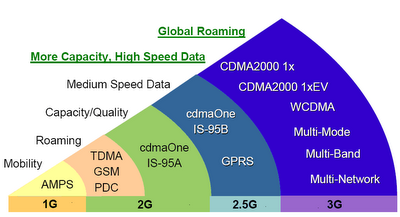
Evolution of wireless technology in last 30 years

Source of image - http://www.teknocrat.com

  • 1G was only for voice communication. It was introduced in the early 1980s

  • 2G was introduced in late 1990. It was planned mainly for voice transmission with digital signal and the speeds up to 64kbps. Facility of roaming was introduced.

    • 2.5G introduced GPRS .

  • What is 3g?

3G  used wide brand wireless network  which increases clarity and gives the perfection as like that of a real conversation. The data are sent through the technology called Packet Switching .Voice calls are interpreted through Circuit Switching.

Not only these but also have entertainments such as Fast Communication, Internet, Mobile T.V, Video Conferencing, Video Calls, Multi Media Messaging Service (MMS), 3D gaming, Multi-Gaming etc are also available with 3G phones.

3G operates at a range of 2100MHz and has a bandwidth of 15-20MHz. Technologies are CDMA 2000,  UMTS, EDGE. Latest technology HSPA & HSPA + 3.5G supports higher throughput and speeds to support higher data needs of the consumers

  • What is 4g wireless technology?

In the 4G wireless networks, each node will be assigned a 4G-IP address (based on IPv6), which will be formed by a permanent “home” IP address and a dynamic “care-of” address that represents its actual location. 4G wireless network, use IPv6 transmission protocol along with digital modulation techniques like Orthogonal Frequency Division Multiplexing (OFDM), which transmits large amounts of digital data over a radio wave. OFDM  is able to compress a lot more data packets through less wireless spectrum’s. 4G also use multiple antennas in their radios which improves for better signal reception as well as decreasing latency.

Voice over HSPA (VoHSPA) enables voice calls to be delivered more efficiently from a spectral standpoint over Packet Switched (PS) rather than Circuit Switched (CS) networks freeing up radio resources for additional data traffic.

A device can achieve a speed of 100 Mps.  Available technologies for 4G are WiMax (Worldwide Interoperability for Microwave Access),LTE (Long Term Evolution). In 4G, Portability is increased further. World-wide roaming is not a distant dream. WIMAX is better choice as next generation mobile broad band service.But, LTE is the choice for real global service.

Here is an infographic on 4g speed using WIMAX & LTE

Current prediction is download speed of LTE will be 1GBPS and upload speed 50 mbps


The idea of WWWW, World Wide Wireless Web (5G), is started from 4G technologies. The following evolution will based on 4G and completed its idea to form a REAL wireless world. Thus, 5G should make an important difference and add more services and benefit to the world over 4G; 5G should be a more intelligent technology that interconnects the entire world without limits.

Currently there is no 5G technology deployed. It’s expected to arrive around 2010. I hope this article help you to understand 3g vs 4g from technical and feature’s perspectives.

Next article, my views on drivers for selecting right technology for 4G for fastest mobile broadband network. Here is an interesting article on 7 Reasons 4G is Better Than 3G ,

Thursday, February 16, 2012

Will iPad 4 and 4G change customer experience in India ?

Market rumor is Apple Inc. appears to be planning to announce the latest version of its tablet computer in the first week of March. This is also reported in huffingtonpost and wsj.

The newest iPad 3 or ipad 4G will feature 4G LTE technology, enabling the tablet to connect to the faster networks on AT&T and Verizon. It is believed that this iPad will support retina display feature along with 10 hour batter life.

Now this latest iPad along with 4G will dramatically improve customers' experience of interactive and capacity demanding services such as web TV broadcasting, online gaming and web conferences.

However, LTE technology is hardly ubiquitous; it’ll take until the end of 2013 for 80% of the U.S. to be covered. But the report suggests the iPad 3 will revert to 3G signal when there’s no LTE available, which makes a lot of sense. 

I hope, Mr. Mukesh Ambani is also keeping information on Apple kitchen and he will kick start his 4g roll out with this latest device. 

I'm waiting to see another Telecommunication Revolution in India after 2003 when Reliance Infocomm brought mobile phone to common mass.

Further reading :What Is 4G? An FAQ On Next Generation Wireless

Sunday, February 12, 2012

9 Ways Indian Telecos Can Improve Their Profitability


Indian telecom companies are stilling following old strategy of customer acquisition and price reduction to increase the market share. I think this will not help because of increasing marketing expenses, cost of operation  etc.

Few years before, the Indian market was so attractive, we saw huge interests from foreign investors. Now, situation is different.

After the latest verdict from Supreme court, Vodafone, Airtell , RCOM are really in  advantageous position.


Source -  www.techonzo.com

Will one of them become a new leader or somebody else?

I spoke with few thought leaders regarding what should be correct strategies to dominate Indian Telecom market . Here are 9 points which e believe can improve the profitability of Indian Telecom companies.

1. Coverage. There are no single operator who has really good PAN India coverage. This is true for CDMA, GSM & 3G network. I think this should be the prime focus for the future leader in Indian Telecom market. 

Companies need to focus on indoor coverages and apartments in high rise building.

2. Price war is killing the service quality. High ARPU customers are not getting the desired service level because all operators are targeting the bottom of the pyramid.

3. Companies should proactively track the customer's problem. People buy fancy high cost handsets/ tablets but most of the time they can not configure them properly. Companies should use latest technology to understand and improve customer experience.

4. Company should focus more on online selling of services and promotion to get high ARPU customers. Companies should be more active in social media segment. India might have more than 1 billion people but actual base of English speaking high ARPU customer ( monthly bill amount INR 450)  is around much less than even 100 million.

6. Companies should invest in value innovation to create new market instead of competing for survival in a crowded place. There are still  huge opportunities to merge entertainment, gaming, mobile TV , M commerce on mobile.

7. Companies should capitalize  mobile advertisement right now. They need to innovate something like Google adwords instead of irritating SMS or direct calling. This will open a complete new revenue stream for them.

8. There are huge revenue opportunities in B2B segments. This is virtually untapped market.Some experts and small business owners was talking about SAAS.

9. Mobile companies can tie up various online stores or emall to sell their products where entire service assurance and fulfillment will be the responsibilities of their partners.

In other words, team thought the standard telecom market is saturated. Companies need to deploy disruptive technology along with blue ocean strategy to create new customers to increase revenue. 

Some telecom analyst believes that Mr. Mukesh Ambani will capture the market these types of disruptive technology which will create new customers for him. He did the same by reducing the price drastically in 2003.Click the link to know more on current state of Indian telecom industry .

Are we going to see another telecom revolution in India ?

Are we going to see an interesting competition between Vodafone & RIL?